
Caleb Holt: Inverting the Offense
The oddball at the top of the 2026 high school rankings, Arizona's Holt has unorthodox qualities to help him overcome some of the perceived shortcomings

Before the 2025-26 season, nobody really expected too much from Arizona - or at least not to the extent they were able to deliver.
The Wildcats were heavily reliant on freshmen like Koa Peat, Brayden Burries and Ivan Kharchenkov, they didn’t really have an offensive engine from the point guard spot in the realest sense of what that role entails, while their big Motiejus Krivas was coming off a foot injury that cost him virtually the entire 2024-25 season.
Arizona were ranked 13th in the pre-season AP poll, only to throw a couple of early season haymakers against elite teams in Florida and UConn. Tommy Lloyd’s squad were arguably the 2nd best team in the nation last season behind Michigan, against whom they ended up losing in a highly anticipated Final Four matchup which ended up a bit too one-sided.
Jayden Bradley was often thought of as Arizona’s leader, but in reality, their main source of success was outrageous size and physicality inside: Krivas recovered from his injury and played better than ever, Tobe Awaka was the best pound-for-pound rebounder in the country, while Peat brought and additional layer of interior presence and vertical athletic ability.
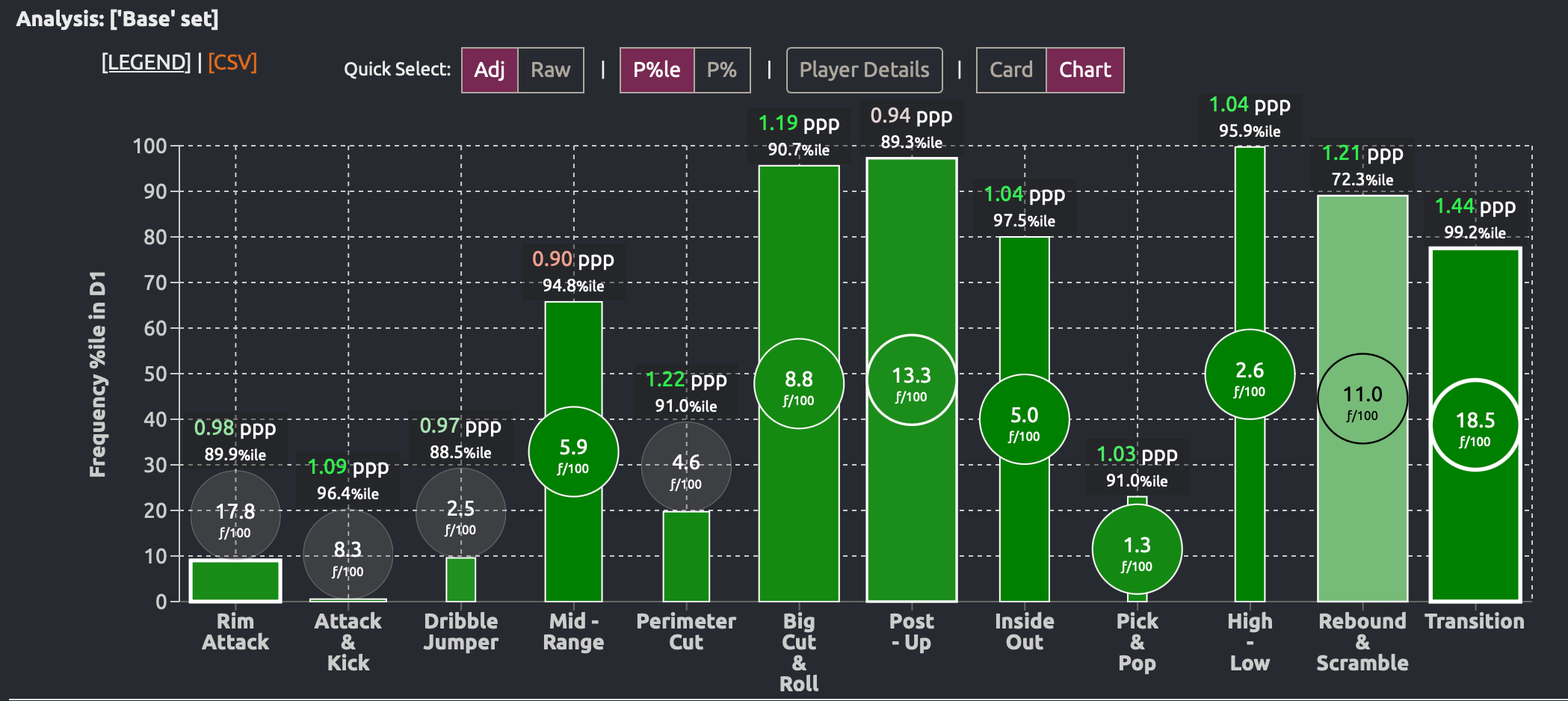
Meanwhile, their guards Bradley, Burries and backup Anthony Dell’Orso mostly played a varying degree of what could be described as an area between a 1.5 and a 2.
Peat, Bradley, Burries, Dell’Orso and Awaka, all major parts of Arizona’s success last year, have all left the program. However, coach Lloyd scored a major off-season coup by bringing back Krivas, a player that, at least in my opinion, is the best NBA prospect from the 2025-26 Wildcats roster. Kharchenkov is also back for a sophomore season, which is huge.
The biggest new piece to complement the returning European core of Krivas and Kharchenkov is star freshman Caleb Holt, the number 2 RSCI prospect in the class of 2026, just below Tyran Stokes.

Holt’s recruitment makes total sense for Arizona: I have some legitimate concerns over his offensive profile from what I’ve picked up, but with Krivas returning and Arizona recruiting JJ Mandaquit to play the point, the Wildcats again don’t really have a PG offensive engine in its truest sense; yes, Mandaquit’s priors indicate him being an excellent and efficient passer, but the shot creation economy isn’t there yet to complete the profile.
As you can see from the pre-NCAA stats above, Holt is closer to an undersized guard-wing hybrid, rather than a lead guard. That’s quite a complicated role to play, and it requires you to bring a lot more to the table than just shooting.
Offensive inversion
Full transparency: all of my evaluations before a prospect has even touched the floor in college are based on incomplete information, blending that info with general playstyle traits that I’ve observed while watching that player myself.
So, that’s where I’m operating with Holt as well. 3.9 assists on 1.2 a/to over 112 games in high school and FIBA competitions doesn’t exactly scream a true lead guard material, nor really does the 24.5% usage. This is a suboptimal coctail for a player that’s very generously listed at 6’5” (I’d guess he’s much closer to 6’3”).
Now, the good news: he’s rumoured to have very long arms, somewhere in the range between 6’9” and 6’10”. With the fiasco of rumours about Keaton Wagler’s supposedly 6’10” wingspan last cycle, I’ll exercise a degree of scepticism until the NBA Draft Combine hits next May.
Whatever Holt measures, his playstyle and bulky frame make him the ‘he plays bigger than he is’ prospect in the class of 2026. He will do a lot at enhancing and compensating for Arizona’s interior presence, which is a pretty odd thing to say about a player sliding right into the guard/wing intersection offensively.
Holt’s 3.2 offensive rebounds per 40 minutes look extremely good even before you adjust these numbers for size. Arizona don’t have Peat or Awaka anymore, but Holt will absolutely do his part at making up for lost offensive rebounding equity from the shooting guard position.
These archetypical oddities are exactly the reason why Holt is such an intriguing prospect that’s capable of beting the untersized wing meta in a unique way.
If we look beyond providing and disproportionate +oREB influence, I believe that arguably the main offensive sell with Holt is that he’s a true outlet for offensive inversion.
Chris Steed, one of my favourite x’s and o’s guys on Twitter, has repeatedly talked about the value of being able to invert the offense, I highly suggest you look up some of his stuff.

Neither Prolific Prep’s, nor Arizona’s roster provides infrastructure for proper 1-5 or 2-5 inversion, but Holt’s high school sample has some fascinating examples where his schematic usage was adjacent to a big.
For example, here Prolific Prep run Holt in a cross action on the baseline to get a deep post position, forcing against a guard that doesn’t possess the requisite physicality nor aptitute for guarding so deep on the block.
On the first play here, Prolific Prep run an off-ball screening action designed to guide their wing and big to the slot and get Holt a deep paint catch. Notice how easily Holt moves his defender to create an angle for the catch on his weak hand.
Second play comes right after with Prolific Prep going with Holt in the post, only for him to get fouled as soon as there’s an entry pass.
Expect Holt to be a difficult assignment in guard-to-guard screening actions, especially as his shot develops further.
Outside of that, historically Holt has had strong free throw rates (40%), seamlessly blending in with Arizona’s physical style of play from last year, which yielded an 11th best free throw rate in the country.
In many ways, as odd as it sounds, Holt is coming in to at least partially replace the output of Peat and even Awaka.
Both of them, especially Awaka’s singular rebounding ability, can essentially only be replaced in the aggregate. With his disproportionate position-relative influence on the offensive glass, as well as with his ability to invert the offense, Holt is likely more important at that particular aspect of Arizona’s roster construction than people may realize.
Last year, the Wildcats’ interior-driven offense dramatically suppressed 3 point rates (363rd in the country), so I’d expect Holt’s volume to sit around, or slightly lower, than what Brayden Burries logged last year (8.6 per 100) on a higher overall usage than Burries had (21.6%).
O decent amount of usage will likely come off secondary actions and play finishing. Prolific Prep liked using Holt in off-ball screening actions, with their best shooter Alex Smith, now of Ohio State, being a strong outlet for backscreening.
Though Arizona don’t seem to have an equivalent to Smith’s movement shooting threat, but they can reasonably run plays for Holt with Krivas screening away from the basket.
Some secondary driving actions can include an empty corner screen rejection, flare screens and stampede drives, though the one caveat I have with Holt operating as a driver off the catch is his average vertical athletic ability off one feet, which can often fail to carry him all the way through to the rim and force to settle for runners/floaters from a few feet out.
Two faces on D
Defensively, Holt has one of the best steal rates on a per 40 basis in the class, yet just 0.5 blocks help reinforce the idea of him being a largely ground-bound player.
Plays like these where Holt snatches the basketball on the defensive glass (before turning it over on the other end) demonstrate that he’s a far superior athlete jumping off two feet, when he has enough time to load and jump off a stationary position.
In terms of team defense, Prolific Prep would usually ask Holt to be very agressive on help actions, sinking really deep into the paint to reinforce the backline defense, converging in the paint and leaving open shooters in the opposite corner.
This isn’t a dig at Holt in any way shape or form as it’s probably how Prolific Prep wanted him to play defense. In that particular clip, this is reinforced by the fact that it was one of the first posessions in the game, so both teams were most likely using coverages that they had planned ahead in practice.
On this play, Holt actually does well to quickly recognize a split p&r coverage on a horns screen, which put Prolific Prep at a major disadvantage. Again, Holt gets very deep and leaves a corner shooter open.
It’s something that I’ve noticed watching these past NBA playoffs: teams are much more willing to leave corner fillers without a ton of on-ball ability or shooting versatility open in order to a) hide their worst perimeter defenders or b) have good defenders roam off them.
Overall, seeing how Arizona tries to utilize Holt defensively will be very fascinating.
Like last year, the Wildcats’ defense will have two distinct faces: one is a drop-based defense anchored by a 7’2” center in Krivas, and the other one is a much smaller set-up based on hard hedging, ball pressure and switchability.
On Krivas-led defensive lineups, Arizona is all about rim deterrence.
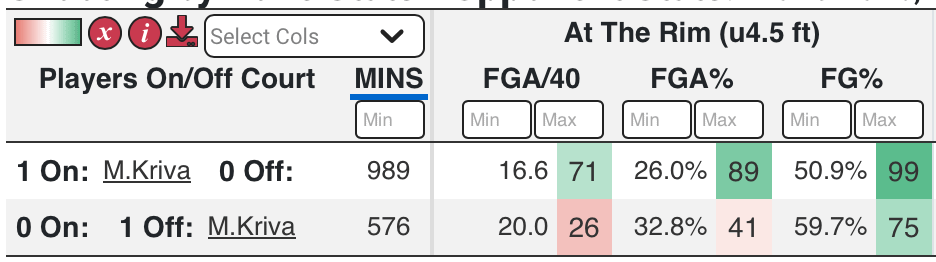
Holt, and for that matter, other defenders in the guard and wing positions, will play a supplementary role to Krivas. On ball, he’ll be required to go over screens and chase ball handlers, trailing them from behind as Krivas drops to guard the paint, while the wings converge and stunt.
When off-ball, Holt will likely guard on the elbows a lot, enforcing the second level of defense to force opposing guards to either pick up the dribble, reset or throw lateral passes away from the basket.
Arizona’s somewhat conservative defensive approach which really doesn’t force that many turnovers will probably put a cap on Holt’s steal rates.
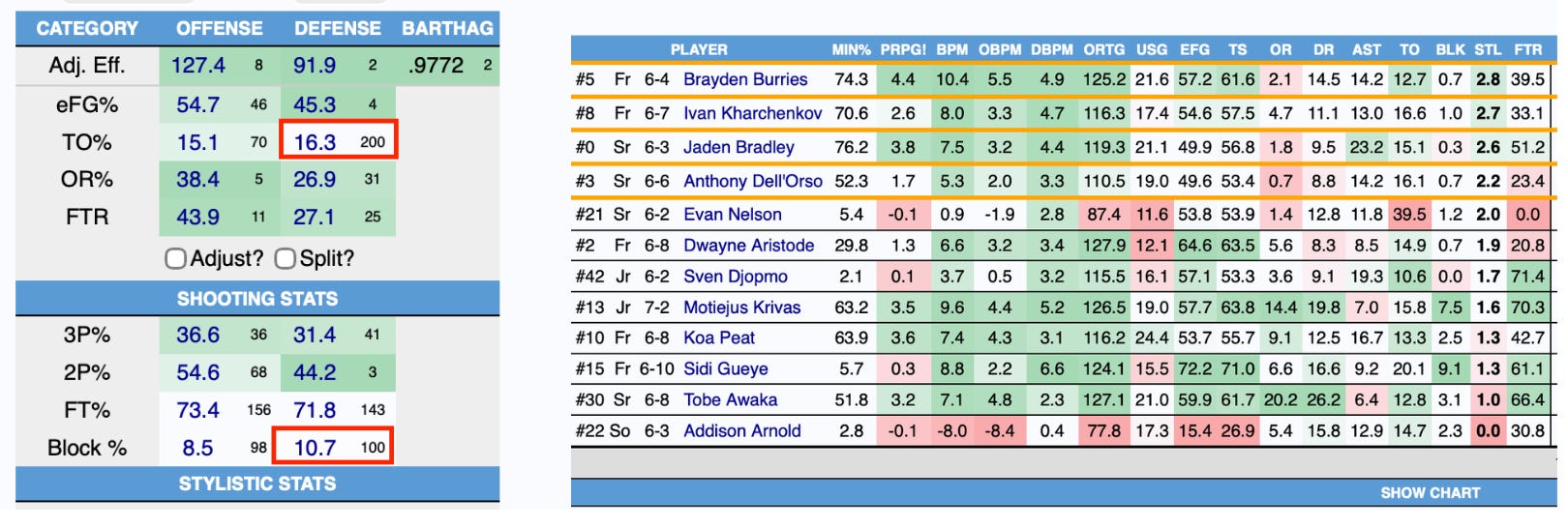
Either way, Arizona’s roster that provides for two different defensive schemes will provide an interesting exercise for his eventual NBA translation.